// Policy and entrepreneurship: a tale of two worlds
This research aims to depict the emergence, evolution and consolidation of entrepreneurship as a policy field thorough text mining techniques. This knowledge will be the basis to propose new policy approaches and detect new avenues of collaboration between the most relevant stakeholders involved in the policymaking process.
// Entrepreneurship Policy Agenda in the EU Explained (Work in progress)
A contribution to understand the European entrepreneurial path and the way forward
As initial step, this research aims to analyse the learning curve of the entrepreneurship-support policy agenda in the EU during the period 1990-2016
1. Which have been the key areas, topics and concepts which have shaped the entrepreneurship policy agenda in the EU since 1990?
2. How have these themes evolved over time? It is possible to propose an entrepreneurship policy timeline?
3. Which are the views of the Academia in the same period? It is possible to establish some relation with policy approaches?
4. Which has the trial-and-error process been? Which are the lessons learnt so far looking into the future?
Preliminary results (work in progress)
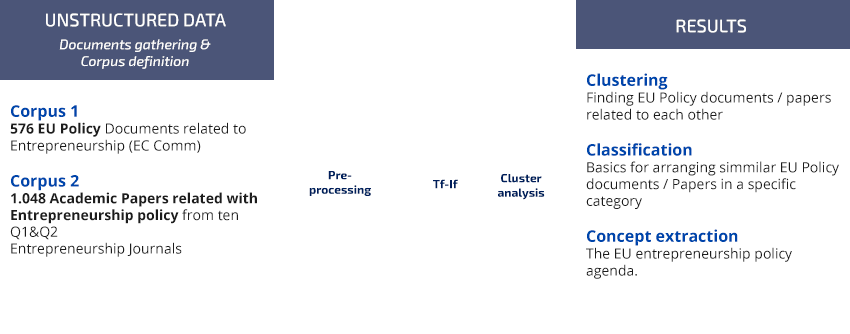
The whole process covers three interrelated objectives: document clustering, finding which European Commission Communications and papers are related to each other; documents classification, arranging similar European Commission documents and papers in a specific category.
Results offer a granular analysis of the emergence and development of entrepreneurship policy in the European Union, establishing an empirical based classification of terms (concepts) and revealing relationships among them and the key factors that are not possible at individual word level.
As an additional output, it will be presented the temporary relation between the academic research in the field of entrepreneurship and the strategic approach of policymakers at European level, showing the evolution of the main themes and concepts in each case and trying to establish patterns and temporal relations between them, contributing to the debate about the knowledge utilization in policy-making.